
Baroque & beyond
Architecture in San Miguel
The historic center has been a UNESCO World Heritage Site since 2008. Baroque churches, colonial mansions and one famously pink parish church rise above streets laid out centuries ago.
November 9, 2026
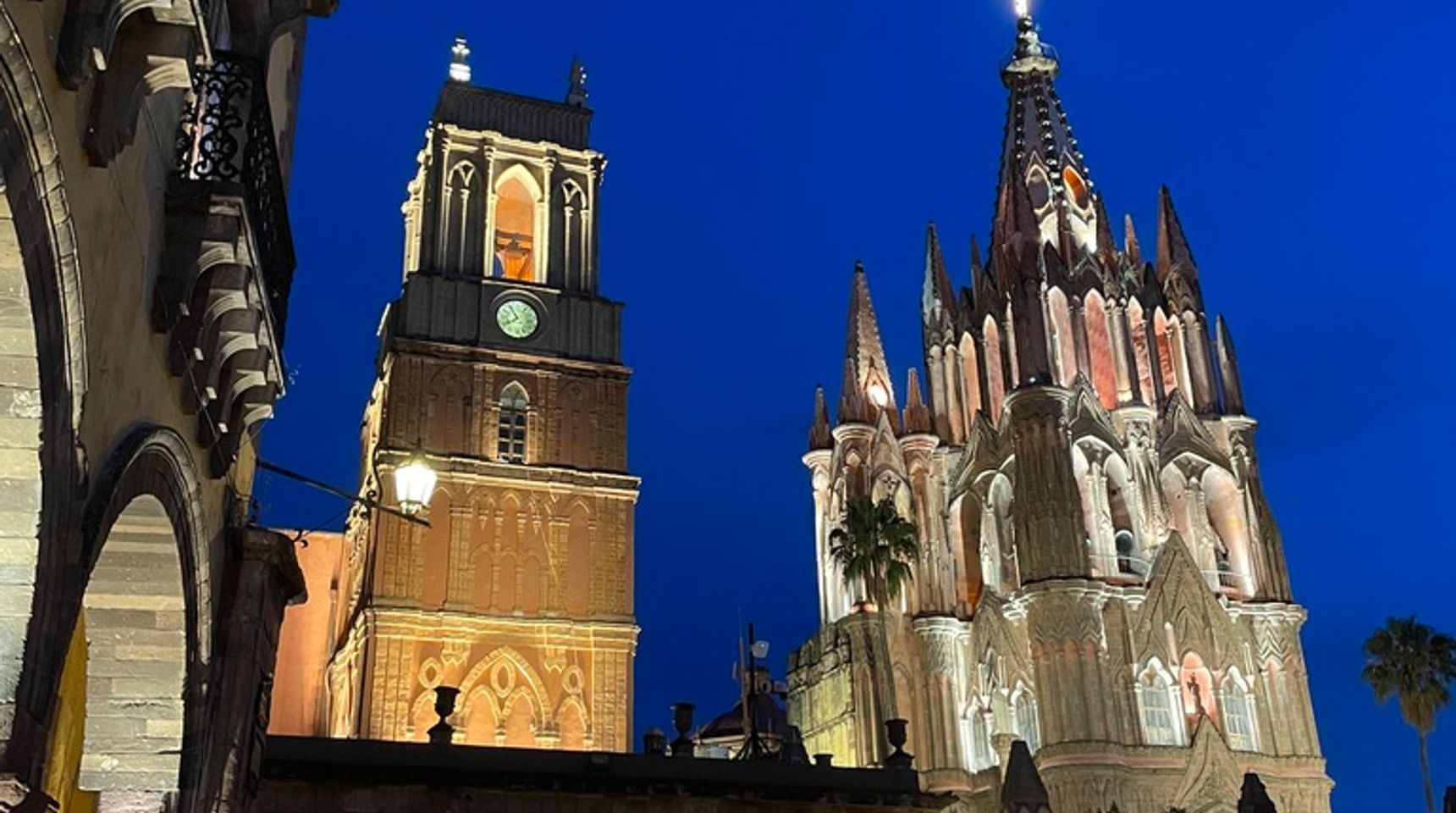
La Parroquia de San Miguel Arcángel
The pink parish church that dominates the Jardín dates to the 17th century, but its neo-Gothic façade was built in the 1880s. It was designed by Zeferino Gutiérrez, a self-taught Otomí stonemason who reportedly drew his inspiration from postcards and engravings of European cathedrals.
The churches around it
The Oratorio de San Felipe Neri, founded in 1712, faces the Plaza Cívica and is a fine example of 18th-century Baroque. Next to it, the Templo de Nuestra Señora de la Salud has a Churrigueresque shell-shaped doorway. The Templo de San Francisco, begun in 1778, has a Churrigueresque façade and a Neoclassical bell tower added in 1799 by Francisco Eduardo Tresguerras.
Convents and mansions
Not every landmark is a church. The Centro Cultural Ignacio Ramírez, El Nigromante, is a former convent founded by María Josefa Lina de la Canal and inaugurated in 1765, and the Casa del Mayorazgo de la Canal is one of the notable colonial houses of the center.
Atotonilco
About 14 kilometers away, the Sanctuary of Jesús Nazareno de Atotonilco, often called the Sistine Chapel of Mexico for its painted interior, was inscribed by UNESCO together with San Miguel in 2008.
Behind the façades, many houses open onto courtyards with fountains and tile. If you are considering a historic home, ask early about its structure and its paperwork, and I will gladly walk you through both.